Showing posts with label Ages 6-11. Show all posts

Sunday, May 24, 2009

Life of Buddha: Skit

Life of the Buddha

Scene 1

Narrator: Let us visit the kingdom of Kapilavastu in the foothills of the Himalayan mountains, more than 2500 years ago. While she sleeps, a white elephant with six golden tusks visits the dreams of Queen Mahamaya.

[Queen lying down asleep. White elephant approaches with lotus flower.]

Narrator: In her dream, the elephant touches her right side with a lotus flower it holds in its trunk.

[Queen wakes up startled. Elephant vanishes.]

Queen: “What can this mean? Husband!”

[King Suddodana approaches.]

Queen: “I must see a holy man! A holy man can tell me what my dream means.”

[King Suddodana leaves and comes back with the holy man.]

Queen: “O wise man, a brilliant white elephant with six sparkling tusks visited me in my dream. He held a lotus flower, and in the flower there was a jewel. He touched me with the flower, and I was so startled I woke up.”

Holy man: “This is good news, my lady. You are going to have a baby, and your prince will be a great leader. He could be a great king, or he could be a great holy man, it all depends.”

Suddodana: “It depends on WHAT.”

Holy man: “If your son becomes troubled when he sees old age, sickness, and death, he will long for answers and will take up the life of a holy man. The world will rejoice.”

Narrator: This worried King Suddodana, because he wanted his son to rule his kingdom one day. The king began to make preparations. He had palaces built with beautiful gardens. He planned for his son to be happy all the time.

[these three leave. Queen returns, pillow in belly.]


Scene 2

Narrator: It is traditional at this time in India for a woman to return to her mother’s home when she is having a baby. Queen Mahamaya is on her way there. She and her handmaidens are passing a forest with flowering trees when she stops, grabs hold of an overhanging branch, and her baby is born. Sweet tea and flower blossoms rain from the sky.

[baby buddha stands up, takes seven steps (lotuses spring from steps) points one finger down, and one finger to the sky]

Baby Buddha: “Above the heavens and below the earth, I alone am the world honored one.”

[queen and king pair up with baby, then new queen and king with baby. Leave at ‘clear away’]

Narrator: Queen Mahamaya names her prince Siddhartha, and returns to the palace. Sadly, she becomes ill, and dies a week later. King Suddodana marries her sister, and she raises the prince as if he were her own. Growing up, the prince needs nothing. The king has all the servants clear away all evidence of decay and death while the prince sleeps. Even so, Prince Siddhartha notices how animals are treated, and this makes him sad.


Scene 3

[Siddhartha enters with Channa, pulling the charioteer along.]

Siddhartha: “Father, please may I leave the gardens and go outside the walls?

Suddodana: “No, son.”

Siddhartha: “But father, Channa will make sure I’m safe. I’ll be ok, I promise! Please may I see the city?”

Suddodana: “I’m sorry, no.”

Siddhartha: “Please, father. I’m a grown man. I have a wife. She is going to have my child. I should take my place as your heir.”

Suddodana: (sighs) “Oh well. I suppose you must. You may go tomorrow, but you must stay with Channa at all times. Promise me.”

Siddhartha: “I promise.”

Narrator: The king relents because he has a plan. He quickly sends his men to the city with orders for the people to keep the old and sick people indoors. He orders all the streets cleaned, gives the people new clothes, and new plants for their gardens. No funerals are allowed. Everybody must smile and look happy for the prince. But despite all the King’s efforts, Siddhartha sees an old woman….a sick man….a dead man all wrapped in sheets….and a holy man so calm and peaceful.

[Siddhartha and Channa see old woman crooked with walking stick, sick man lying down, dead man with sheets, holy man in robes. They leave. New scene:]

Siddhartha: “Channa, I must leave my home. I must find the answer to all this suffering.”

Channa: “Your father will never allow it.”

Siddhartha: “I know. I can’t bear to say goodbye to my beautiful wife and our new baby. I will leave at night, and you will help me.”

Narrator: “Channa takes the prince out of the city. The prince gives Channa his royal clothes and jewels and walks away. His horse and Channa are both crying. Siddhartha chops off his hair, and puts on the discarded tattered yellow robe of a hunter.


Scene 4

[Gautama sits down as the narrator speaks.]

Narrator: Siddhartha Gautama looks for a holy man to be his teacher. None can teach him how to end suffering. He meets five monks who show him the practices of eating very little and causing himself pain. They say THIS is the way to Truth. Gautama practices this way until he almost dies, he is so thin.

[a girl comes along and leaves a bowl at Gautama’s feet. Gautama picks up the bowl, eats, puts the bowl down. Sits. Then gets up and stretches and smiles.]

Gautama: “Ahhh! I feel so much better! My mind is clear. The pleasures of the palace did not help me to understand the Truth, nor was it right to starve myself. Through a Middle Way I can find the Truth. I am sure of it.”

[(bodhi tree moved in place) Gautama splashes himself in the ‘river’ and goes to sit under the bodhi tree.]

Gautama: “I will not leave this seat until I have found the Truth.”

[while narrator speaks, Mara enters, glaring. Demons enter, rush at Gautama, try to scare him. Try to make him giggle. Demons leave. (thunder, snake umbrella rises over) Beautiful dancers return, dance in front of him.

Narrator: Seeing that Gautama could actually overcome his ignorance and desire, Mara, the Great Distractor, joins Gautama under his tree. He calls up his demons, who rush at Gautama, try to scare him. The demons try all kinds of things to move Gautama from his seat. Siddhartha Gautama does not move. The demons throw rocks at him. The rocks turn into flowers. The demons give up. Mara calls up thunder and lightning…………..Siddhartha does not move, and the King of the Cobras shelters Siddhartha under his hood. Mara calls up beautiful dancers. Gautama does not move.

Mara: Who do you think you are?! You don’t have what it takes!

[Gautama calmly reaches down with one hand and touches the earth.]

Earth: I am your witness. You have what it takes.

[Mara gives up, and leaves. Gautama sits. A small light appears …Crack of the wooden blocks.]

Buddha: That’s it! That’s it! All…. illuminated!


Scene 5

[The Buddha gets up, stands and looks at audience, gesture with hands as narrator says ‘teaches many years’. Lies down on side when narrator says ‘right up to his death’. Ananda approaches, wipes his forehead.]

Narrator: Thus, Siddhartha Gautama becomes the Buddha, the Awakened One, at the age of 35. He teaches many years, giving us many profound lessons, such as the 4 Noble Truths, that is that, One, we all experience suffering, Two, the cause of suffering is attachment, three, we can end suffering by ending attachment, and four, we can end attachment by following the Eightfold Path. He teaches right up to his death at the age of 80. Ananda takes care of him at his deathbed.

[many followers gather around, wringing hands, crying, pulling hair.]

Ananda: Please don’t die. If you die, who will be our teacher? We need you. Who will show us the way to enlightenment?

Buddha: Do not be sad when I die, my friends. Everything that has a beginning has an ending. The world goes on. Didn’t I teach you that you must find your own way to the Truth?

Ananda: Yes.

Buddha: I have taught all I could. I held nothing back. You have everything you need. The Dharma is your light and your refuge in this world. Remember, you must be your own light.


Props: pillow, elephant tusks, 7 lotus flowers, bower/branch, walking stick, sheets, bodhi tree (umbrella), large cobra snake head


Sunday, April 26, 2009

Life of Buddha: Review

For a review, we went over the lessons covered, and the girls put together booklets with foam covers they could decorate.

I got the pictures from this website: Life of the Buddha in Pictures.

Here is the document for the booklet of Buddha's Life.


Sunday, February 22, 2009

Life of Buddha: The 4 Noble Truths

 I gave the girls an opportunity to learn another kind of walking meditation, outdoors.
I told them you want to pay attention to your body and how it touches the ground, how your breath moves with your body. How fast you go is up to you, but, you don't want to lose track of that concentration. If it helps you can try one of these ideas.
  • Visualize this: with every step you take you're sending roots down into the ground, roots that sprout. Behind you, lotus blossoms sprout. Think of lotus blossoms sprouting from your footsteps.
  • Think of your favorite animal. Think of how that animal is trying to be very quiet and not seen by other animals. It pays attention to  its body and knows exactly what its body is doing. You can pretend to be that animal.
  • Simply concentrate and pay attention to your breath and to how your body feels as you move and your feet touch the ground.
You're better off starting out slowly. If you feel like you can speed up and keep concentrating, you can do that. You don't have to follow each other; you can branch off and you can turn around. Bells ring to start and to end.
They liked that the meditation was fun, that they could turn around, go any way. I explained that this was a good meditation for getting used to keeping that concentration while moving, even while doing tasks. A neat thing about it is that you can do it in disguise...so if you feel that need for that calm feeling of meditation, you can do this kind of meditative focus.

Earlier I'd requested we sing our song, "The Four Noble Truths," and now I reminded them of it, and told them that this is something that all Buddhists share, that we study the Four Noble Truths as the Buddha taught us. For that reason I chose this to represent the teaching part of the Buddha's life. I had them help me remember the Four Noble Truths from their knowledge of the song.
  1.  Everybody suffers just like you.
  2. We suffer because we grasp and crave.
  3. We can end the suffering by ending the craving.
  4. We can end the craving with The Eightfold Path. 
I reminded them of the Three Poisons: Greed; Hatred; and Delusion. These are what form the craving or attachment.

I went over the Eightfold Path with them, they helped. Right Understanding or View is seeing things as they really are. Right Intention is having a commitment with a positive emotion toward that commitment. Right Speech: don't lie; don't be mean with your words; don't gossip. Right Action (pretty straightforward). Right Livelihood. One volunteered "don't kill." So I asked, if someone is a butcher, is that Right Livelihood? In some Buddhist traditions, it would not be. However, in other traditions, if they do their job with care for the animals, so the animals don't suffer needlessly, it could be Right Livelihood. Right Effort: taking care; being thoughtful; doing your best. Right Mindfulness: paying attention. Right Concentration: as we discovered with the walking meditation, it's possible to bring that concentration to other parts of our life.

While they colored their copies of the Four Noble Truths with an image of an 8-spoked Dharma Wheel, I shared some very short stories that demonstrated this. These were made into stickers. I used the pop-up book Fishing for the Moon and other Zen Stories by Lulu Hansen. These are the things I drew out of the stories:

Fishing for the moon 
1. Mistaken about the moon in the well. “something terrible” they want it to be right.
2. Excitement clouds their thinking. They’re attached to it being right.
3. Understand clearly to end this attachment.
4. Right Understanding. Right Effort -> they did have this

Parable of the Strawberry 
1. Man in fear for his life.
2. Panic, clinging to life; attached to a future
3. Be present in this moment to let go of the wish for a particular future.
4. Right Mindfulness, Right Understanding

Girl on Muddy Road 
1. Monk annoyed, angry over breaking of the rules.
2. Attached to the rules, pushes away any distractions, afraid he’ll stray from his intention.
3. Concern about the spiritual effort of others blinds him to his own. Following rules doesn’t mean effort is correct. Thinks pushing distractions away makes you strong
4. Right Understanding, Right Effort, Right Mindfulness, Right Action

Sunday, February 08, 2009

Nehan Instruction and Meditation

We have a little time before the ceremony to give instruction.

As I've noted elsewhere, I've found it helps with ceremonies to give some guided instruction during meditation. Then they have time for a quick check-in, which I use as a way for them to think about their roles in the ceremony. In this case, I gave instruction first, and I borrowed a technique from another tradition, Worship Sharing of the Friends. I explained it was kind of like combining their check-in with meditation.

I shared the story of the woman and the mustard seed to introduce death and loss.

  The Buddha met a woman who had lost her baby son. She was devastated. She had heard the Buddha could perform miracles. So she went to the Buddha, and she was holding her son, and she said, "Buddha, can you bring my son back?"
  The Buddha could see she was very distressed, and there wasn't much he could say, so he said, "I want you to go to every household in this area. If you can find a household that has never experienced loss, bring me a mustard seed from that household."
  So that woman did that. She went to every household and found out the losses that people had experienced. Doing that, she realized that she was not alone, that everybody experiences loss.  She was able to start letting go of her baby that she had lost.
  Finally she came back to the Buddha. He said, "Do you have a mustard seed for me?" And she told him, "No, I don't. But I'm ready now to let go of my son."

That is what our ceremony is about today, I said. There are people that come into our lives, and they go away, they die. Here is an explanation of the Nehan Ceremony. Then, the worship sharing medition...I explained that we don't sit so formally like we do with our regular meditation. We face each other, but don't want to be too distracting to others. If we feel like we have something we wish to share, we do that.

Sunday, January 25, 2009

Life of Buddha: Death

There were quite a few people in the class, some new, so I took some extra time with meditation instruction:
  I want everybody to do their absolute best to be very quiet. No talking, and no body language talking. By that I mean no silent talking to your friend. We're going to do some meditation that's all about focusing on your own breath and your own body. Like the Buddha under the Bodhi tree, we're gonna allow those distractions to float on by. ...even with the drums going on next door, we're just gonna let that float on by.
 I began the lesson speaking of the ceremony Nehan, which we would celebrate at the next Dharma School.  We remember those who have died in our lives, whether people or pets.

I shared various pictures of the gathering that happened when the Buddha died. The Buddha was about 35 when he experienced enlightenment, but he died when he was around 80 years old. He knew he was going to die, and accepted a tainted bowl of food despite knowing that. His cousin Ananda nursed him, and wished to save him. He was always the one who remembered what the Buddha said. Ananda begged, "If you leave us, who will be our teacher? Who will show us the way to Nirvana and Enlightenment that conquers all suffering?"

Everybody gathered round, they didn't want the Buddha to die. They were wailing and suffering. The Buddha smiled. He gave the most important talk of his life. He said, "Don't be sad, my friends. Remember, all things that have a beginning must have an end. And haven't I taught you that the only way to Nirvana lies in you. You must find if for yourself." He said, "Be a light unto yourself. You'll find your own wisdom in yourself, and you can pass that on to others, just as I have to you."

For checkin I had asked the girls to share one thing of the truth in their life...something of their own wisdom. I reminded them of the song, "This Little Light of Mine." I asked, "What is your light? What is something in your life that is your light that you can offer, your wisdom? It could be a word, like joy, or peace, or happiness. You could surprise me. What is your light? What is your truth?" I got such answers as caring, animal lover, kindness, generosity, music, creativity.  I told them this was why, to remind them of their own wisdom that they already have, and that they can pass on to others.

The Buddha taught us a way to uncover that truth and that wisdom. When Buddha reminded Ananda of that, Ananda nodded. Buddha said, "Keep the light that glows within you burning, for it alone will lead you to truth." Keep the light that shines within you, like the song.

This is how we get the Dharma of Buddhism, like one light passing to another, from teacher to student.

For a craft, I had little heart-shaped tins (favor tins) with a lid with window to see inside. They could paint with paint pens or use sharpies. They could choose 3 polished decor stones to put inside, for use in meditation.


Sunday, January 11, 2009

Life of Buddha: Under the Bodhi Tree

There are always different numbers of girls who come to Dharma School. I have to plan to be able to handle a lot, or a few, girls in the class. When a few, we can spend more time in discussion. When many, I can only hope that something of the lesson sinks in. I may never know what the thing is that will light them up. On this day had a full room, as well as a guest who is working on putting together his center's Dharma School program.

For this lesson I had a special craft I know they love: shrinky dinks. Unfortunately I spent enough time finding the art and preparing it that I ran out of the time I like to spend on reflecting on the lesson itself. I read through my materials, but as far as class went, I was winging it. Fortunately, I've been doing this awhile.

There were several new girls in class, as we allow new attendees at the beginning of the school year, and in January when we return from a December break. I realized I needed to spend a little time with review of how the hour is spent.

Because the Buddha is said to have walked around the Bodhi Tree in meditation after he experienced enlightenment, I taught them walking meditation. We do a very slow walking meditation. I showed them how to hold their hands, gave them some guidance on focusing their attention inwards, and on their breath, and began. I walked them through their first couple of steps. Take a breath in and lift your foot, let your breath out and put your foot down. You might take another breath before you move again, and that's ok. Find your own rhythm as you lift your foot.....and put it down. I believe I injected something about doing this silently because I needed to. Some of the girls are quite comfortable in class, and that means they're busy catching up and connecting with each other.

Because we had so many girls in such a small room, we slowed to a standstill, so I decided we would not spend more than those couple of minutes on meditation. I had asked a new girl to light the incense, and a new girl to snuff it. (With so many girls I didn't have the time to figure out who had already done what task. To be fair, I've been keeping a list.)

I spent a little time explaining check-in, that we go around and say our names, and say something about ourselves. Sometimes it might have to do with the lesson, and sometimes it could be something we want to share with the others. This day, it needed to be one thing about ourselves, and we needed it short. I had a lot of "I don't know what to say." Perhaps when I have such a number of mixed new and returning, and many, students, I need to remember to be more directive with that check-in topic. They are always assured they don't have to say something if they don't want to.

Funny thing is, one girl thought to ask what the craft was that day. I said it was something special, and she would simply have to wait.

I read from Demi's Buddha about Buddha's enlightenment, first asking if anybody remembered the last lesson. The Buddha had learned he couldn't figure this out if he starved himself, and he couldn't if he had too much wealth. That this discovery was called the Middle Way, and that the metaphor often used is a lute, or a stringed instrument. And that because their life in modern times in the United States was very different from the Buddha's, that their Middle Way would look different than the Buddha's, and it was up to them to figure out their own Middle Way. Sounds like a lot, but some remembered these things.

So, from Demi:
One morning Siddhartha accepted a bowl of rich milk and rice from a village girl. With his energy renewed, he was determined to find the Truth of life over death, the end of suffering for himself and for all people. He bathed in the Nairanjana River and then walked to a large bodhi tree, a spot where many Buddhas had been enlightened. Along the way, a cowherd offered Siddhartha eight handfuls of grass to sit upon. He spread the grass beneath him under the tree. 
  Siddhartha vowed, "Even if my blood dries up an my skin and bones waste away, I will not leave this seat until I have found the Truth; life over death; the end of suffering for myself and for all mankind!"

I commented, some people say evil, you might say distractions or things that keep you from experiencing enlightenment....
  Mara, the Evil One, heard this vow and called upon his army of demons to defeat Siddhartha's enlightenment. Mara planted doubts and fears in Siddhartha's mind. He conjured whirlwinds, darkness, rain, and lightning. The earth cracked before Siddhartha; trees crashed around him. But the purity of his mind dispelled Mara's power. Mara hurled a shower of meteors; they changed into heavenly flowers around the tree. The evil One could not move Siddhartha. 
  "The seat of virtue is mine!" Mara thundered. "Who can say it is yours, Siddhartha?"
  Then the earth shook and thundered its reply, "I, Earth, can say that the seat of virtue belongs to Siddhartha, for I have witnessed his goodness in this life and in all his former lives!"

The Buddha touched the earth when he said this. About this point I was wishing I'd had more time to do this reflection, and I riffed on the main point of this lesson, the Earth as Witness. I said this is a good thing to remember, say, if you're feeling a lot of distractions, if you feel your thoughts or your emotions are all over the place, is to get in touch with the ground, and actually touch the ground. In this modern world, we might say we 'need to get grounded.' It can be helpful if you do actually get closer to the ground, to the earth, to feel more centered and focussed. So you may often see Buddha statues in this position, with one hand touching the ground, and they call this the Earth Witness Buddha.


I showed them images and pulled out a few phrases from the other book I was using, The Prince Who Ran Away. I knew they would like the image of the king of the cobras sheltering the Buddha when Mara sent the rains.

Using more images I'd found on the web, again I riffed. Have you ever had such a feeling that inside you it rained flowers and the earth trembles and the birds are singing? One girl was nodding vigorously. This is what they are trying to convey with these images....

So, the craft. I gave them the choice of coloring in a preprinted Earth Witness Buddha...and they had a choice of several...or drawing a picture that had to do with the lesson. One girl asked, "Can I draw..." and I said I would prefer if she chose something from the lesson. I also began by saying they could only have one, just one shrinky dink. It was a good thing I had a guest. I gave him the task of punching a hole in their completed shrinky dink, so they could hang it by a thread if they wished. My co-teacher helped them with their drawing and any other needs, including snack. I did the heating with the mega-blow-dryer.

You can get full-sized sheets of shrinky dink plastic at a store like Michael's that can be sent through a copier. Some can go through a bubble-jet printer. You create the document for the art you wish to use, print it on paper, and using a copier, hand-feed the plastic for the copy. You need to test which side gets the print, then feed so that the frosted or rough side goes through oriented to that side. I had colored pencils for those printed pieces, and I had colored Sharpies for the opaque white or beige artwork if the girls so chose. There was an even mix. When it comes to art, I find it is good to have that choice, so they can feel good about what they create, whatever their skill level.

Here is the document I used for their printed shrinky dink plastic pictures of the Buddha touching the earth.  


Sunday, November 23, 2008

Life of Buddha: The Middle Way


I used a combination of my own narration, and some excerpts in verse from The Light of Asia by Sir Edwin Arnold.

After Siddhartha left home, he cut off his hair, and traded his clothes for old yellow robes. He joined some monks, or yogis, who thought if they deprived themselves, and treated their bodies in extreme ways, they could achieve a certain wisdom. This old poem form of the story has wonderfully grotesque descriptions of the scene. However, it would work better for children a little older with more vocabulary. Also, it is good to begin a lesson with a vocabulary game of some sort, covering those more complex words.

Siddhartha nearly died, but a girl passing by offered him some food, which made the monk realize his old life of riches didn't give him what he needed, but neither did this life of deprivation. It is compared to a musical instrument, the lyre, this middle way that he found. The key is not to make the strings too tight, or too loose.

I asked the kids if they had examples of "too much" or "too little" like this. Not really, so I discussed the Buddha's two extremes some more.

For our activity, I created a coloring page using imagery from the coloring book, and an image of a lyre. In the instrument, I punched holes so the girls could insert some glittery string, taping it on the back. Here is the Middle Way coloring page.

Sunday, November 09, 2008

Life of Buddha: Encountering Suffering

Various picture books of the Buddha's life have different qualities that make them good. I chose bits from each of the three books for this lesson. I reminded the girls of The Charioteer Song that we sing sometimes. This story, they are familiar with.


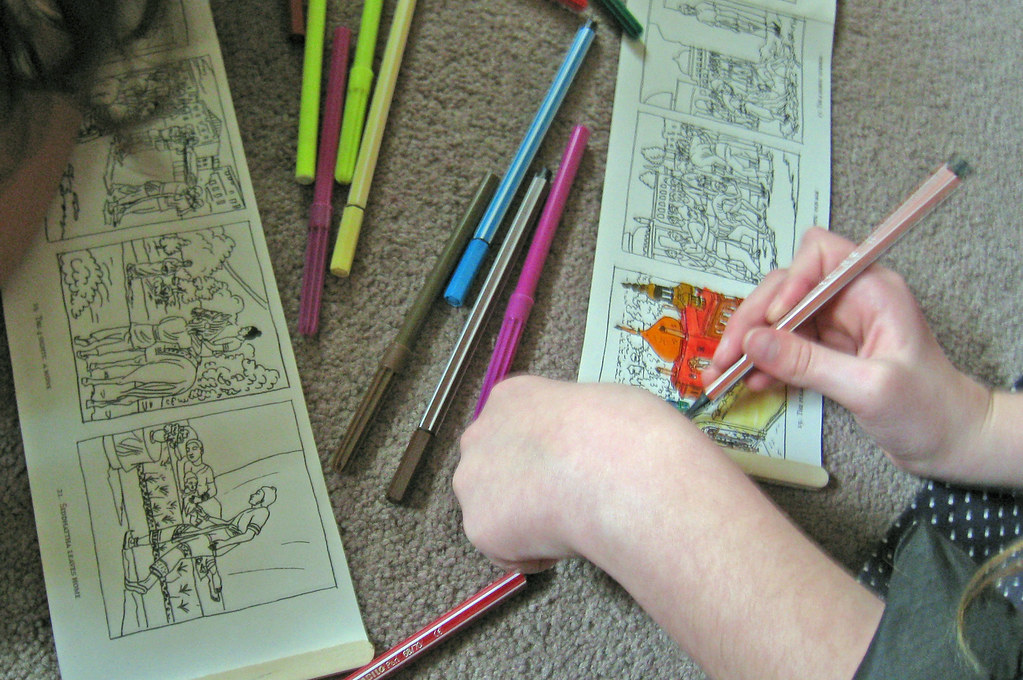
For an activity, I created a scroll using the images from the coloring book of Buddha's life. Click for the Buddha's four sights away from the palace. For prep, I printed, cut in half, pasted the two pieces, and pasted popsicle sticks on the ends.

To learn the full story of the 4 sights that prompted Siddhartha to leave home, see the song:
The Charioteer Song page 1
The Charioteer Song page 2


Sunday, October 12, 2008

Life of Buddha: Devadatta

The next lesson after this is the ceremony Segaki, and it seemed to me Devadatta makes a good example of a Hungry Ghost. While I would have liked to teach the Buddha's life in a chronological order, I liked the idea of relating his life to our ceremonies more, so the story of his birth comes much later in the year when we celebrate Wesak.

Image found here
I shared the story of Siddhartha, the young Buddh-to-be, with Devadatta and the Swan from the picture book Buddha by Demi.

While Siddhartha's father protected him from seeing old age, sickness, and death, he still got into things with his cousin Devadatta, as boys do.  In this story, Devadatta shot down a swan, and Siddhartha caught it to nurse back to health.


Each boy considered the swan to be his, so they took the disagreement to the court, where it was decided Siddhartha could keep the swan, as life is sacred.

While I told the story, I had the girls color a picture of the swan story from Story of the Buddha: A Coloring Book found at buddhanet.  (There is also a text book that includes the images and more text.)

Once done, we moved on to creating a swan origami. To accommodate the younger ages, I sought simple swan origami instructions. The kids had a choice, to keep the origami separate, or to paste it to their picture.

Sunday, September 28, 2008

Life of Buddha: Buddha as Teacher, Awakened One

IMG_1777IMG_1764IMG_1765IMG_1766IMG_1767IMG_1768
IMG_1769IMG_1770IMG_1771IMG_1772IMG_1773IMG_1774
IMG_1775IMG_1776IMG_1778

Dharma School 9/28/08, a set on Flickr.
I keep the first lesson simple when there are many kids returning who know each other. I need to allow for time for them to catch up, reforge their bonds. I concentrate on reviewing what we do in Dharma School, paying more detailed attention to altar and meditation instruction.

Looking at the Buddha as our Teacher and the Awakened One fits right in with this introduction, and with introducing the year's subject.

There are several picture books I use for this year's lessons. For this introduction about the Buddha teaching, I used just one page from The Prince Who Ran Away: The Story Of Gautama Buddha by Anne Rockwell.

I allowed more time for the activity of painting pictures of the Buddha using paint pens.

Sunday, June 08, 2008

Six Realms: Skit: Heaven Meets Hell

This skit came from the girls' idea of Heaven meeting Hell. When they held up the mirrors to each other, the audience loved it. All parts in blue are repeated by the chorus.

Heaven Meets Hell

Narrator: Somewhere, in some time, perhaps right now, there's a being who found herself in heaven, and through good merit lives the life of a deva.

[A deva is enjoying herself. She finds flowers. She dances around. A ukulele plays.]

Chorus: Life is good. No worries. Happy happy joy joy. ….Sleeeep.

Life is good. No worries. Happy happy joy joy. ….Sleeeep.

[The deva dances around the chorus, puts the flower in the arrangement on the altar, and lays down for a nap. Chorus stops chanting on 'sleeeeep.' She dreams.]

[Two people in the hell realm rise up from somewhere, bump into each other, and start fighting.]

Chorus: They hurt me. I hate them! It's not my fault! I will hurt THEM! They hurt me. I hate them! It's not my fault! I will hurt THEM!

[The two people swing sticks, echoes the heaven dance, but more foot pounding. Hit a cushion on 'THEM'.]

[The deva wakes suddenly with that whack.]

Deva: Was that a dream or a vision?

Narrator: Our lovely deva was not going to rest with this question, though devas in heaven love to lounge around and sleep. She decides to visit the wish-fulfilling tree.

Deva: Oh Tree. I would like a tool that can tell me what place this was, or if this was just a dream.

[The deva is handed a ?camera ?small tv.]

Deva: It is true. There is a place they call hell, and the people there are so mean, and in so much pain. Oh Tree, please give me a tool that will take me there so I can help them.

Narrator: Well, my friends, you know what that means, don't you? Our beautiful Deva has just opened the door to Bodhisattva training. Without thinking about her own safety, she wants to leave her luxurious heaven to help those angry beings. Naturally, this summons a Bodhisattva, who says,

Bodhisattva: I can take you there, but such a journey comes with a condition.

Deva: I am willing.

Bodhisattva: You must know that you are stepping onto a difficult path, but a noble path. You will find you cannot turn away from suffering. You will find you put others before yourself.

Deva: I am quite willing.

Bodhisattva: You are quite sure about this?

Deva: I am most definitely willing.

Narrator: So the Bodhisattva took the Deva by the hand and led her to the Hell Realm. First they traveled past the realm of the Fallen Gods.

[They move clockwise around the room. The chorus follows.]

Chorus: I want that. You don't deserve that. I deserve that. It should be mine. I will take it! I want that. You don't deserve….

Narrator: And on they went past the animal realm.

Chorus: I need food. I need sleep. I need babies. You are prey. I need food…

Narrator: And the Bodhisattva led the Deva past the center of the Wheel of Life, where the three creatures of the poisonous passions whirled.

[3 of the chorus ring around the rosy saying:]

1Choral: Gimme. Gimme. Gimme…

2Choral: I don't want to know. I don't want to know….

3Choral: Get away. Get away. Get away…

Narrator: and the two arrive in hell, where they see lord Yama and many beings in torment, including the 2 fighters from the Deva's dream.

[the two are fighting again, face to face]

Narrator: Our brave Deva asks the Bodhisattva,

Deva: How can we help them?

[the Bodhisattva hands her a mirror, and she holds one too.]

Bodhisattva: On three. Ready? One….Two…..Three!

[each holds her mirror in front of one of the fighters. Each fighter sees her reflection, stops, covers her eyes with her hands, breaking the arm locks.]

Bodhisattva: The best way to help someone in the Hell Realm is to help her see herself clearly. It is painful, but not as painful as Hell itself. ….Come. There is more you can do.

Narrator: So the Bodhisattva leads the Deva further clockwise, back up toward Heaven, and past the realm of the Hungry Ghosts.

Chorus: I am thirsty. Oh! It burns! I am hungry. Oh! It tastes awful! I need something! I am thirsty…

Narrator: And the Bodhisattva leads her even further to the Human Realm.

Bodhisattva: Now, my lovely Deva, you may return to the Heaven Realm, where life is good, there are no worries, and you can sleep. But I recommend you stay here, where all the realms are reflected, and you can do the most good. [Chorus chants softly: Compassion! Love! Joy! Peace!] Humans can think of others. Humans can change, and you can help them. You can take the bodhisattva path.

Deva: As I said, I am willing. [All join the chorus Compassion! Love! Joy! Peace!]


Sunday, April 27, 2008

Six Realms: review

I was a bit ambitious with this review...it was too much to cover in one lesson. While I intended to cover it in two, we needed to spend our time on our skit practice. Click on the pictures for a larger image. The girls relished trying to come up with the answers, though some of the details were new to them.


And here are the answers:


Sunday, April 13, 2008

Six Realms: The Human Realm

My co-teacher Kim led this lesson.  She started off with a game.  People drew fortunes from a little box Kim shared.  Here are some of the fortunes as examples:
You will do great in school and go to a good college.
You will make it a practice to ask Kanzeon, the Bodhisattva of Compassion, for help every time you fell worried.
You will get an exciting job at the zoo, and one day you will get bitten by a hippopotamus.
You will break your leg and not be able to go on a ski trip with your friend, but the leg will heal completely.
You will marry a person you love very much and will enjoy that person's company for many years.
Kim drew out some of the aspects of the fortunes, things that can occur in the Human Realm.  Some of them involved losing something important to them, bad things happen, good things happen.  Some were things they would do in Dharma School, they could choose.

When Kim asked which realm they would prefer to be in, one child said the Heaven Realm, but another said the Human Realm, because in the Heaven Realm they didn't always keep caring about others.  Kim said the thing about the Human Realm, is it does contain bits of the other realms, but not to such extremes, and that it is easier to get off the Wheel of Life in the Human Realm.  It is more possible to make choices.

For a craft, we had them "draw the comic strip of their life, with Kanzeon as the hero."  We talked about the Thousand-Armed Kanzeon with her many tools, and how these tools help us in our human life.  We also included more objects for our altar this day, including some household tools.

Sunday, February 24, 2008

Six Realms: The Asura Realm

After meditation, for check-in I asked the girls to name something they really wanted but weren't able to have. Maybe somebody else has that thing.

When I introduced the Asura Realm, I pointed out the wish-fulfilling tree.  Did they remember that from the Heaven Realm.  The trunk and roots are in the Asura Realm.  If you look closely, you might find some of those people trying to cut it down because they want the fruits of that tree.  They feel they ought to be able to have them.

I told as story called The Magic Tree, reworked from the tale told by Uma Krishnaswami, found in Shower of Gold.  See my version of the story here. I've included elements a narrator might like to draw out in conversation.

For a craft, I used a foil art kit I found in the chain drugstore nearby.  I related it to the Asuras, as these people are fond of acquiring shiny, glitzy things.  The kids could make their own shapes, using glue, or pre-cut stickers, to stick the glue on one side, and to another surface on the other side.


Foil Art kit

Sunday, January 27, 2008

Six Realms: The Heaven Realm

My co-teacher began this lesson with a lying-down yoga meditation. She got them comfortable on the floor, making sure they were not touching each other by giving them gentle directions. She did some guided meditation, then carefully brought out her ukulele to make a big, sudden sound. It woke them up! Kim used this to demonstrate how we can get sleepy and complacent when we have an easy life. We had the kids look closely at the Asura, or Fighting Gods Realm. We asked them what they could see (clouds, building, tree, forest, etc). Then Kim taught them more about the myth of the Heaven Realm. The people who live there are the Devas. People got to this realm by doing good things in their lives. People in Heaven get to sit around and play games, and are waited on. They never sweat. Basically those things we might all think of when we think of Heaven. The city, she said, is called Lovely. There's a wish-fulfilling tree in Heaven, as well as a forest. Sometimes people want to get into Heaven and attack them. The people don't want to fight, of course. They use the power of the magical forest in those cases. People there are concerned about others, but they can become sleepy and complacent. "Not my concern," one child responded. The other problem about Heaven...it doesn't last forever. It's good to enjoy Heaven realms while we have them, but not to get too attached. For the craft activity, Kim prepared a poster on which the kids could put their own bits of Heaven. They had paper for themselves as well, so they could take something home. Five years later, the poster still hangs in the Zen Center library.

Sunday, January 13, 2008

Six Realms: The Hell Realm

I have a couple of lessons that we covered in November that I started writing about but haven't finished. We did this lesson on the Hell Realm in January. I've been noodling around with Web 2.0 for work, so I decided to create this Google slideshow presentation. Enjoy.


You can view a larger version here.

Sunday, November 25, 2007

Six Realms: The Beast Realm

The Animal Realm is one that kids understand instinctively. Kim led the discussion, asking the kids some leading questions that elicited this understanding. "How many kids have been told 'you're acting like animals'?" The conversation continued. "How do animals behave?" We were looking for answers like eat, fight, sleep, run. Animals don't think beyond their immediate needs.

Kim asked, "Do animals plan for 3 years in the future?" ..."Do animals go to school?"

"Nooooo."

"What do humans have that animals don't have?" The answer she was looking for is that we have a mind that allows us to be reflective, to think beyond the needs of the immediate moment, and to be concerned about our ethical behavior. We have the ability to choose to do good deeds, do refrain from doing bad things like stealing and killing.


Some of the girls were particularly sensitive to the fact that some animals do appear to make choices and do good things, so we talked about that. They were thinking of pets that save their humans, or of working animals. These animals are trained to do the deeds they know how to do, or their help arises more out of instinct than out of thoughtful reflection. As humans, we have the ability to think carefully and choose the wiser actions. Kim and I emphasized that we were talking more about the beast aspect of animals, not so much those animals with those loving and helping instinct.


Finally, we asked the question, "What can humans do that gets us out of the animal realm?" Kim had already mentioned one, study, or school. Meditation. Self-reflection. We can choose not to get caught up in those self-involved activities of the animal realm.

For an activity, Kim had them play charades in which the children acted out an animal. Only 1st or 2nd graders could use noises. Once they figured out the animal, she had them figure out the descriptive word from a list of words about the animal. Sharks --> violent. Cows --> dull. Snakes --> sneaky. Squirrels --> hoarders. Pigs --> greedy. Donkeys --> stubborn.

If I were to do this again, I would not stereotype the animals so much, as those sharp girls had more sophisticated views of animals, and resisted labeling all animals as this or that type.

For the craft, Kim had a list of the precepts, and the kids decorated covers for their precept books, complete with glitter glue and stickers.

The traditional antidote for beings stuck in the animal realm is thoughtful study.


Sunday, November 11, 2007

Six Realms: The Hub


For this lesson I began with a straightforward exploration of the center of the image of the six realms, the hub. I explained that the image of Lord Yama is said to be holding up a mirror, and image of our own self.

The turning of the wheel of the six realms is driven by the 3 kleshas at the center. We talked about the hatred of the snake, the greediness of the rooster, and the ignorance of the pig. Greed is "gimme," anger is "get away," and ignorance is "huh?". We keep this on this wheel because of our karma, because of these three poisons.

As much as I could, I would show the kids various depictions of the six realms, and exploration of the art helped us understand the lesson.

While I told them a story that had elements of greed, anger, and delusion in it, I gave them images to color of Yama holding up the six realms.

The Clever Rabbit and Numskull is found in Asian Children's Favorite Stories: A Treasury of Folktales from China, Japan, Korea, India, the Philippines, Thailand, Indonesia and Malaysia. A greedy lion eats the animals, and the animals agree to offer themselves one by one so the lion won't eat them all. Well, one clever rabbit tricks the lion, taking advantage of his blind, angry greediness, and saves the animals from having to sacrifice themselves.

For a quick craft activity, I prepared refrigerator magnets, one an image from the story, another of the 3 animals of the kleshas.

Sunday, October 28, 2007

Segaki Ceremony

Every year as part of our liturgical calendar we have the Segaki retreat and ceremonies. Retreat participants look at past karma appearing in the present, and pay homage to those that have died. In our Soto Zen tradition, this calling up of karma stews in people for up to a week, culminating in two cathartic ceremonies. On the morning of the last day of the retreat we invite the gakis, or hungry ghosts, into the temple. We cover the images of the Buddha, and prepare the altar with enticing goodies, especially donuts.

[Photos courtesy of Faddah Yuetsu Wolfe]
Chants include dharanis that have some shamanic influences. The gakis are with us through the day, and in the evening the ghosts are laid to rest and let go in the fire of Segaki Toro.
After the adults have invited the hungry ghosts in the morning, the children enter the hall and have their own Segaki ceremony. This year our priest told them the story of Moggallana and his mother in hell. (See above link.) Then we began singing a portion of the ceremony. It is while we sing that actual gakis enter the ceremony hall. Our gakis are high school students in costume. They do a fine job.


The gakis are pretty clueless about ways to act in the hall, and they can't seem to get the food in their mouths.
It is the job of the kids in this ceremony to help the gakis learn how to act in a Buddhist temple, and help them be able to eat.

It is our job as teachers to prepare the kids for the ceremony. We inform or remind them about what is going to happen, and we figure out ways together that we can help the gakis. At the grade school level, some of the kids are aware that the gakis are the high school students in costume. At this age, part of their role in the ceremony is to help the younger ones participate in the ceremony. This year, just what the gakis could learn was clarified so we could give more direction to the kids.

We made sure they knew to help the gakis with these four things: 1) taking their shoes off; 2) eating - slowly and delicately rather than shoving the food in or keeping the wrapper on; 3) sharing - with each other; 4) bowing

Since bowing was one of the tasks, I made bowing our meditative activity, and gave a small lesson on the form of a full bow.

Sunday, October 14, 2007

The Six Realms: The Hungry Ghosts

We had quite a few more girls for this class. Some were brand new to dharma school, and others were quite familiar with the subject of hungry ghosts. Kim led the class, and using the image of the six realms, led a discussion on gakis, also known as hungry ghosts.


[Image from this website.]

Gakis wind up where they are due to greediness. In the six realms, there are two kinds of greediness. In the case of gakis, they have the feeling they don't have enough and can't take in nourishment. They have forgotten how. They want, and will do whatever they need to get, even lie, but they still can't be satisfied. If they can learn to be nourished by what they have, and to share, they have a chance of getting out of the Preta Realm. (Later in the school year we will cover the kind of greediness found in the Asura Realm.)


Several girls remembered that gakis have big stomachs but tiny necks and tiny mouths. Water turns into fire, and food turns into some disgusting thing, often related to the greedy reason they ended up in this realm. Together we strategised ways we could help the gakis learn to eat and to share.


For an activity, Kim had an outline picture of a gaki, and various grains, beans, and pasta to glue on the picture, especially in the gakis' stomachs, along with a bowtie pasta for the neck. The pasta mosaic was popular with the girls.